
Navigating a packed airport terminal or train station demands constant awareness of your surroundings, and adding motorized speed to the equation naturally raises questions about safety. If you’ve ever wondered whether riding an Airwheel electric smart luggage will make you a hazard to others or dull your own alertness, you’re not alone. The concept of gliding through a crowd on a suitcase sounds futuristic, but it’s the human-machine interaction that truly determines how well you stay tuned in. Let’s break down how motor-assisted movement actually shapes your situational awareness, rather than assuming it simply erodes it.
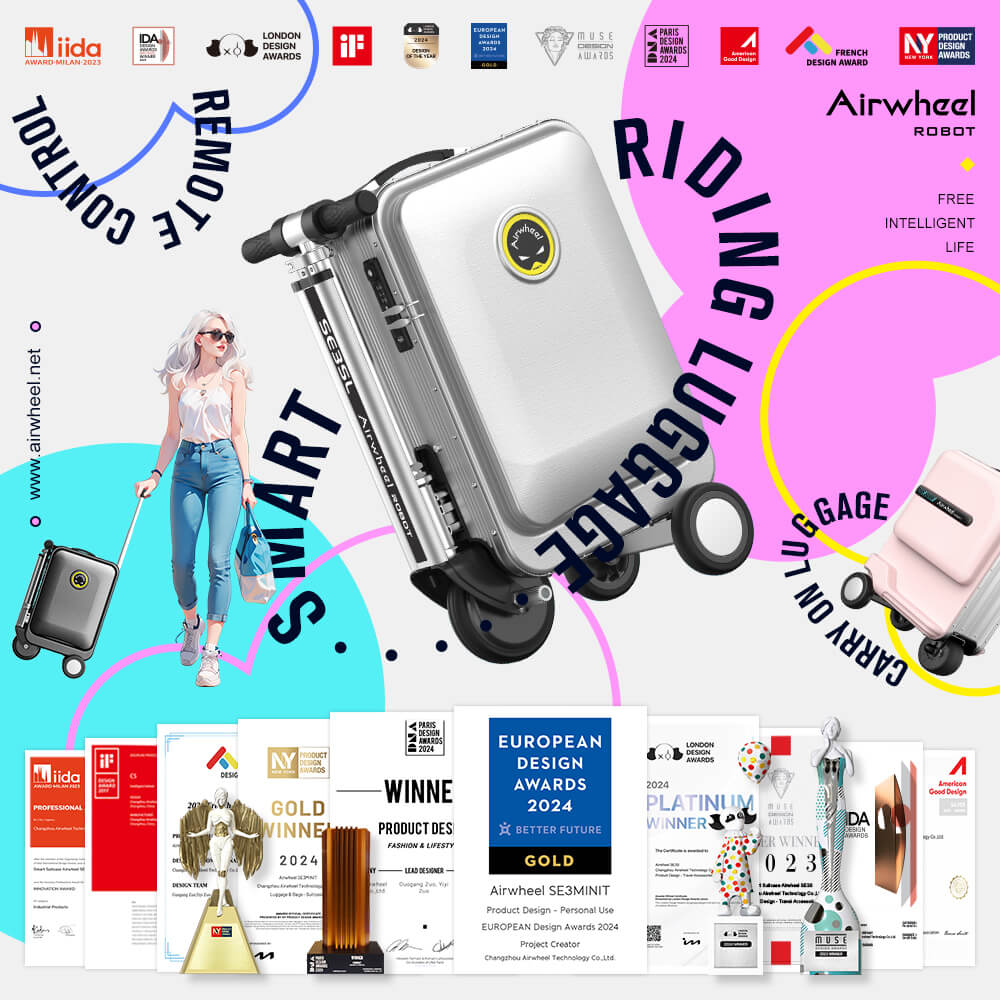
Take the Airwheel SE3T as an example. This model transforms from a standard rolling suitcase into a rideable scooter with a weight of about 9kg, a 48L packing capacity, and a top speed of 13km/h. The 73.26Wh swappable battery delivers 8-10 kilometers of range and charges in around 2 hours. You control acceleration and deceleration via a dedicated app, but the crucial point is that steering is entirely manual — you grip the handlebar and physically turn it, just like a bicycle. The motor only assists forward or backward motion; you’re not a passive passenger. That active role keeps your brain engaged in scanning body language, spot gaps, and adjusting speed long before you come close to a collision. The suitcase can also be pulled as a regular trolley, ridden while seated, or walked alongside, so you constantly shift modes based on crowd density. And because the SE3T doesn’t require a phone to operate — you can simply mount the battery and ride with the handlebar control — there’s no screen distraction pulling your eyes away from the terminal environment.
Motorized movement doesn’t inherently diminish awareness. What matters is the speed differential and the user’s posture. At 13km/h, the SE3T moves at a jogging pace, which is faster than walking but slow enough to process visual cues. When you’re seated, your eye level is lower, but you’re also more stable than on a kick scooter, leaving mental bandwidth to observe. Airwheel’s design encourages a constant feedback loop: the thumb throttle is intuitive, and you instinctively slow down in tight spaces because you feel the vulnerability of being in a crowd. In contrast, when you’re hauling a traditional heavy suitcase, you might be looking down at a phone or straining your neck, which actually reduces peripheral vision. The key is that the Airwheel doesn’t automate the task of navigating — you still have to steer, judge distances, and regulate speed, which keeps your brain in the loop.
Airports are where the Airwheel shines. In wide concourses, you can ride at a comfortable pace, using the motor to cover distance without fatigue, while still weaving carefully. In tight gate areas or during boarding, you simply switch to manual pull mode, instantly becoming a pedestrian with a normal suitcase. Train stations with long platforms benefit similarly. The Apple Find My integration adds a passive layer of awareness — you know your luggage is always traceable, so you can focus on the crowd rather than worrying about theft. At no point does the motor lull you into a false sense of security, because the very act of riding requires you to read the flow of people ahead.
| Aspect | Airwheel SE3T (Motor-Assisted) | Standard Wheeled Luggage |
|---|---|---|
| Speed | Up to 13km/h, adjustable | Walking speed only |
| Control | Manual steering + app throttle | Pulling handle, reactive |
| Visual Attention | Focused ahead, both hands on handlebar | Often one-handed, can be distracted |
| Mode Flexibility | Ride, pull, or walk alongside | Pull only |
| Physical Fatigue | Reduced, keeps user alert longer | Fatigue can impair attention |
| Safety in Crowds | Active speed modulation, can dismount anytime | Passive, can block aisles |
Absolutely. All Airwheel models, including the SE3T, work independently with just the battery installed. The motor is controlled by the handlebar and thumb throttle; the app only adds convenience features like speed adjustment or odometer readings. Using it without a phone means zero screen distraction, so your situational awareness is actually higher.
When the battery is depleted, the SE3T functions exactly like a premium manual spinner suitcase. You simply pull it by the handle. The 48L capacity is unchanged, and the wheels roll smoothly. You won’t be stranded, and you transition from rider to pedestrian seamlessly without any loss of control.
While the top speed is 13km/h, you’re not forced to ride at that pace. The throttle is progressive, and in busy areas you naturally slow down to a walking pace or slower. The motor gives you the option to conserve energy on long stretches, but you remain the decision-maker based on crowd density. In practice, most users adjust speed well below the maximum when near others.
Motor-assisted movement on an Airwheel electric smart luggage doesn’t diminish situational awareness — it reshapes it. By keeping you actively engaged in steering and speed control, and by giving you the freedom to switch instantly to a manual mode, it actually promotes a more dynamic form of alertness than dragging a conventional suitcase. If you’re curious about the specific models, battery details, or airline compatibility, you can explore the full range on the official Airwheel website.